Some of the most exciting new stories begin with very old ideas.
Across generations, Indian traditions have explored questions about knowledge, courage, responsibility, self-discovery, listening and our relationship with the world around us. These ideas have survived not because they belong only to the past, but because many of the questions behind them remain meaningful today.
For modern storytellers, ancient wisdom can provide something incredibly valuable: inspiration.
It does not mean simply retelling an existing myth. Instead, timeless ideas can become the foundation for new characters, new mysteries and completely original adventures.
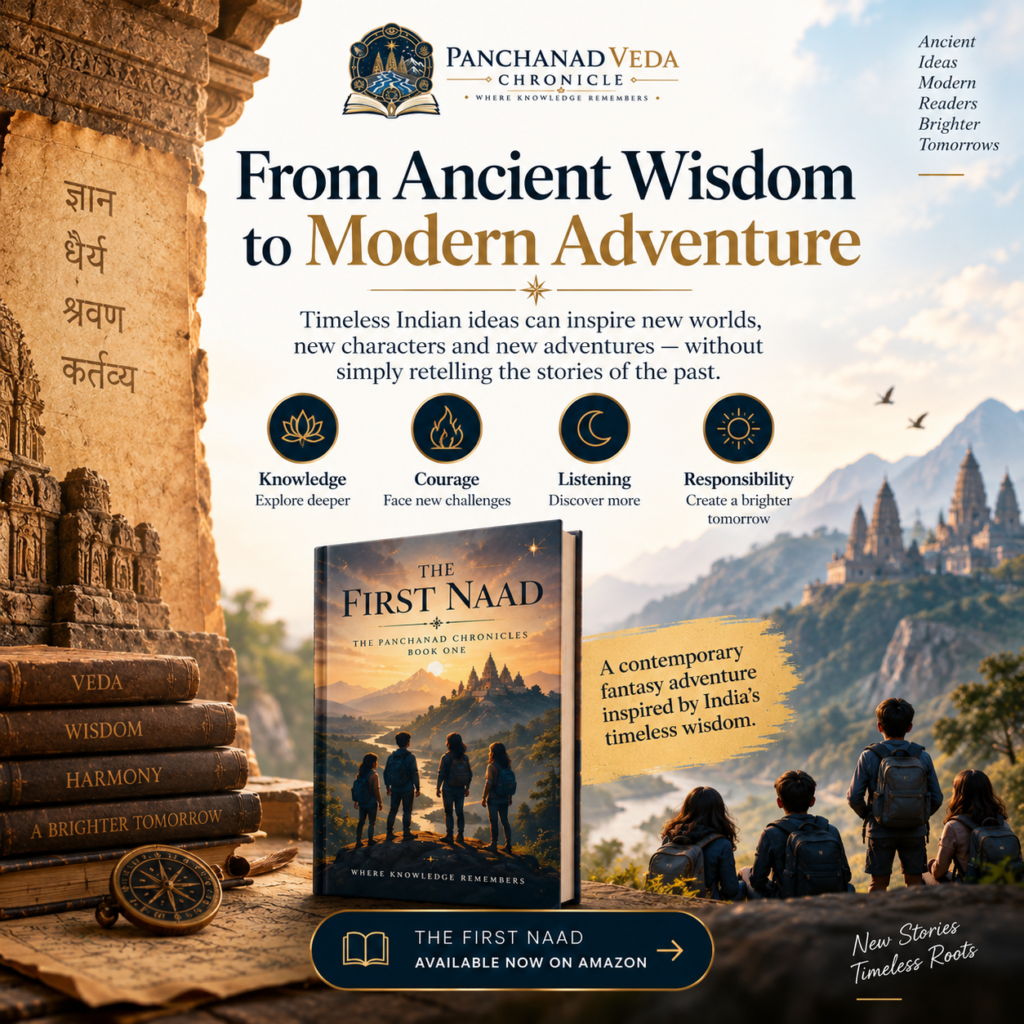
That philosophy sits at the heart of The Panchanad Chronicles and its first book, The First Naad.
Ancient Ideas Don’t Have to Stay in Ancient Stories
When we think about mythology or ancient traditions, it is easy to imagine stories belonging to another time—distant kingdoms, legendary figures and events passed down over generations.
But the ideas within those traditions can still speak to modern readers.
What does it mean to have courage?
When should we act, and when should we listen?
Does knowledge bring responsibility?
How do we decide what is right when there is no simple answer?
These questions are not limited to one period of history. They are just as relevant to a young reader today as they were to generations before.
Contemporary fantasy provides an opportunity to explore them in a completely new setting.
Inspiration Is Different From Retelling
There is an important distinction between retelling an ancient story and creating something new from the ideas it inspires.
A retelling takes an existing narrative and reinterprets it.
An inspired story can take broader concepts—philosophy, symbolism, landscapes, cultural memory and ways of thinking—and use them as creative foundations for an original world.
This gives writers the freedom to ask:
What could an ancient idea mean to a child living today?
How might traditional concepts influence a modern mystery?
Could something associated with history become the beginning of a completely new adventure?
The result can feel connected to cultural heritage while still giving readers a story they have never encountered before.
Symbols Can Carry Stories Across Generations
Symbols are another powerful bridge between ancient ideas and contemporary storytelling.
Fire can suggest courage or transformation.
The sun can represent clarity and illumination.
The moon can evoke patience, reflection and calm.
Rivers can represent movement, connection and memory.
Sound can lead us towards ideas about listening, communication and knowledge.
A fantasy writer can take inspiration from these associations without turning them into literal explanations.
Instead, symbols can quietly enrich a fictional world, giving readers something deeper to discover beneath the adventure.
Ancient Wisdom Can Ask Modern Questions
One of the most interesting possibilities in fantasy is using an extraordinary situation to explore a very ordinary human decision.
Imagine discovering something that has been hidden for generations.
The obvious fantasy question might be:
“What can it do?”
But perhaps the more interesting question is:
“What should you do with it?”
That small shift changes the story.
Knowledge is no longer simply a reward for solving a mystery. It comes with responsibility.
For young readers, questions like these can introduce ideas about consequences, judgement and personal values without making a story feel like a lesson.
The adventure remains exciting, but there is something meaningful underneath it.
Bringing Indian-Inspired Fantasy Into a Contemporary World
India offers an extraordinary landscape for fantasy storytelling.
Its rivers, mountains, architecture, languages, traditions, philosophies and thousands of years of cultural history provide countless sources of creative inspiration.
Yet Indian-inspired fantasy does not always have to take place in an ancient kingdom.
What happens when that sense of history exists alongside classrooms, school friendships and everyday childhood?
That contrast can create something distinctive.
A modern young character can encounter an idea with roots far older than anything they know. Familiar places can suddenly contain unfamiliar questions.
The past and present begin to exist beside one another.
The World Behind The First Naad
This approach helps shape the world of The First Naad, Book One of The Panchanad Chronicles.
The story is set in contemporary Punjab and follows four young friends—Aarav, Veer, Kavya and Meera—at Panchanad Veda Sthal High School.
They are modern children with different personalities and instincts.
Aarav wants to understand.
Veer is ready to act.
Kavya listens.
Meera notices what others overlook.
Around them is a world influenced by Indian heritage, landscape and ancient ideas—but their adventure is an original one.
The story is not simply about uncovering something old. It asks what happens when a new generation encounters knowledge it does not yet fully understand.
Knowledge, Courage, Listening and Responsibility
Four ideas are particularly important to the wider world of The Panchanad Chronicles.
Knowledge encourages us to look deeper rather than accepting only what appears on the surface.
Courage is not simply fearlessness. Sometimes it means making a difficult decision despite uncertainty.
Listening reminds us that understanding does not always come from speaking or acting first.
Responsibility asks what we should do with what we learn.
Together, these concepts create possibilities for adventure while also giving young readers ideas they can continue thinking about after the story ends.
Why Cultural Inspiration Matters for Young Readers
Stories can be both windows and mirrors.
For some young readers, Indian-inspired fantasy can provide an opportunity to see elements of heritage, landscape and cultural thought reflected in an imaginative adventure.
For others, it can provide a window into ideas and settings they may not have encountered before.
Both experiences matter.
Fantasy has always allowed readers to travel beyond the familiar. Expanding the cultures, philosophies and traditions that inspire those imaginary worlds only gives young readers more places to explore.
New Stories, Timeless Roots
Ancient wisdom does not need to remain behind museum glass or within the pages of history.
It can inspire questions.
It can inspire characters.
It can inspire imaginary worlds.
And it can help storytellers create adventures that feel both new and connected to something much older.
That is part of the idea behind The Panchanad Chronicles: timeless inspiration, contemporary characters and an entirely new adventure for today’s young readers.
Begin the Adventure with The First Naad
Set in contemporary Punjab and inspired by Indian heritage and ancient ideas, The First Naad introduces readers to four young friends whose ordinary school lives begin to intersect with questions that have been waiting much longer than they realise.
For parents, teachers and young readers looking for a middle-grade fantasy that combines mystery, friendship, Indian-inspired storytelling, curiosity and adventure, this is where the journey begins.
📖 The First Naad — Book One of The Panchanad Chronicles is available now on Amazon.
The Panchanad Chronicles
Where Knowledge Remembers.