What happens when ideas carried for thousands of years meet a completely new story?
Fantasy has always borrowed from the past.
Ancient legends become mysterious worlds. Old questions become new adventures. Symbols that have survived for centuries find new meaning in the hands of another generation.
India offers an extraordinary landscape for this kind of storytelling.
Its mythology, philosophy, architecture, landscapes and storytelling traditions contain ideas that reach far beyond gods, heroes and legendary battles. They ask questions about knowledge, responsibility, courage, identity, consequence and the choices people make when confronted with something greater than themselves.
These are ancient ideas.
But they are also remarkably modern ones.
And for young readers especially, they can become the beginning of extraordinary new adventures.
Mythology Is More Than a Collection of Old Stories
When we hear the word mythology, it can be tempting to think simply of stories from the distant past.
But mythology has always done something more.
Stories allow generations to explore questions that don’t necessarily have simple answers:
What makes someone courageous?
What responsibility comes with knowledge?
When should power be used—and when should it be restrained?
How do our choices affect other people?
What do we owe our friends, families and communities?
Those questions are just as meaningful to a child opening a fantasy novel today as they were to people listening to stories generations ago.
That is one reason mythology remains such fertile ground for fantasy.
It gives writers something deeper than magical creatures and spectacular settings.
It gives them ideas.
Ancient Wisdom Doesn’t Require Retelling Ancient Stories
There is an important distinction between retelling mythology and creating something new that draws inspiration from it.
Both have their place.
But an Indian-inspired fantasy world doesn’t necessarily need to recreate an existing legend.
A writer can instead explore the ideas surrounding those traditions.
Concepts of knowledge and learning.
The importance of listening.
The relationship between teacher and student.
Respect for the natural world.
Self-restraint.
Duty.
Courage.
The consequences of how knowledge is used.
These ideas can become foundations upon which completely original characters, mysteries and worlds are built.
That approach lies at the heart of The Panchanad Chronicles, which presents an original middle-grade fantasy world inspired by Hindu mythology, Vedic philosophy and India’s cultural heritage rather than simply retelling a familiar myth.
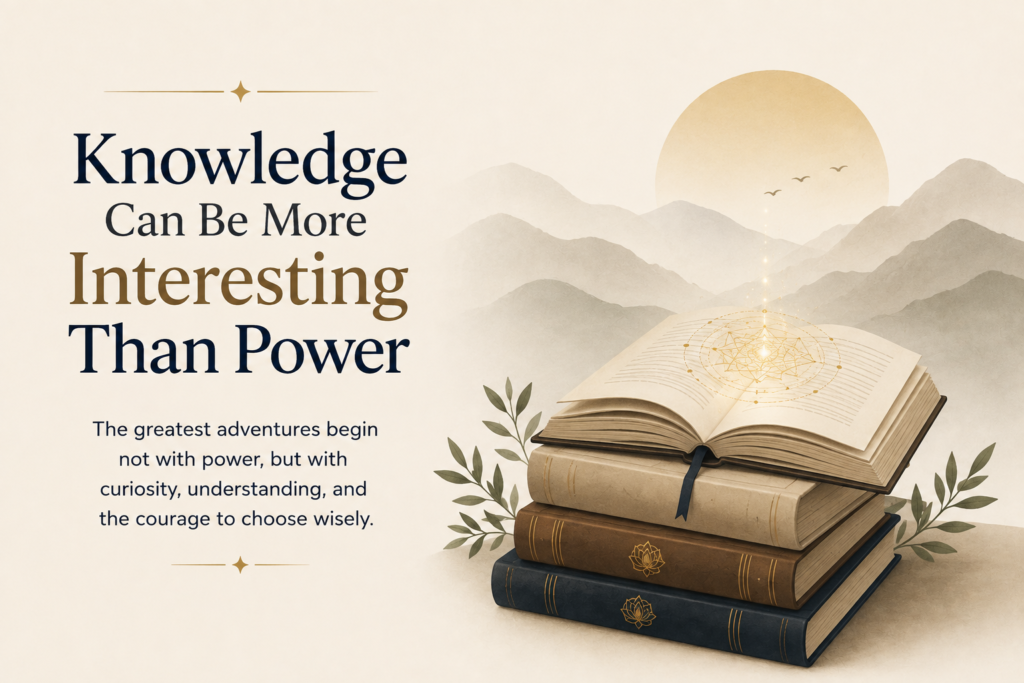
Knowledge Can Be More Interesting Than Power
Fantasy frequently asks a familiar question:
What would you do if you suddenly had extraordinary power?
But there is another question that can be even more interesting:
What would you do if you discovered extraordinary knowledge?
Knowledge changes the person who possesses it.
Once something has been understood, it cannot simply be unknown again.
And knowing something doesn’t automatically mean we should use it.
That creates fascinating possibilities for children’s stories because it shifts the idea of heroism away from simply becoming stronger.
A hero might instead need to learn patience.
Or restraint.
Or responsibility.
Sometimes courage means acting.
Sometimes courage means refusing to act.
And sometimes the greatest challenge is understanding the difference.
Listening Can Be an Adventure Too
Modern life rewards speed.
We scroll quickly. We answer quickly. We move quickly from one thing to another.
But many traditions of learning begin somewhere quieter:
with listening.
Listening requires attention.
It means noticing what others overlook.
It means accepting that understanding might come before answering.
For a young reader, that creates an interesting reversal of the traditional fantasy hero.
Perhaps the person who notices the faintest sound matters as much as the person carrying the sword.
Perhaps the child who stops and thinks sees something everyone else misses.
Perhaps silence itself can contain information.
Suddenly, listening isn’t passive at all.
It becomes part of the adventure.
India Is Already a Fantasy Landscape
Fantasy worlds often send readers searching for distant mountains, forgotten buildings, ancient rivers and places filled with history.
India already contains landscapes capable of inspiring all of them.
Consider the Himalayas rising above river valleys.
The Beas winding through northern India.
Ancient temples and sacred spaces.
Old courtyards.
Mountain settlements.
Forests disappearing into mist.
Rivers that have supported communities and accumulated stories for generations.
Architecture, geography and history can therefore become part of storytelling without needing to imitate the medieval-European settings traditionally associated with fantasy.
The Panchanad Chronicles, for example, places its young protagonists in contemporary Punjab and centres its mysteries around Panchanad Veda Sthal High School, where an apparently recognisable school environment exists alongside hidden architecture and secrets older than the buildings above them.
That combination is important.
The ancient world doesn’t have to exist somewhere far away.
It can exist underneath the ordinary world we already know.
Symbols Give Fantasy Another Language
A lotus isn’t simply a flower.
A river isn’t simply water.
Fire isn’t merely heat.
A mountain isn’t only stone.
Across Indian traditions, natural elements, objects, sounds and geometric forms can carry layers of symbolic meaning.
Fantasy gives writers the opportunity to play with this visual language.
A young reader may first encounter something because it looks mysterious or beautiful. Curiosity then encourages them to ask:
What does that mean?
And that question can lead somewhere much bigger.
Into history.
Into mythology.
Into philosophy.
Into another culture.
Or simply into another book.
That is one of storytelling’s quiet strengths: entertainment can become the doorway to curiosity.
Why This Matters for Young Readers
Children between eight and twelve are already asking surprisingly large questions.
What kind of person do I want to become?
Where do I belong?
Why should I do the right thing when nobody is watching?
What makes somebody a good friend?
When should I speak?
When should I listen?
What happens when I make the wrong decision?
Middle-grade fantasy can explore these questions without turning them into lessons.
Instead, readers experience them alongside characters.
They watch friendships tested.
They see mistakes made.
They encounter consequences.
They wonder what they themselves would have done.
And because all of this happens inside an adventure, the ideas can stay with them long after the adventure ends.
A New Generation Can Discover Ancient Ideas in New Ways
Ancient traditions survive because each generation encounters them differently.
For some, that happens through family.
For others, through history or philosophy.
And sometimes it begins with something as simple as a story.
That is where modern fantasy has an exciting opportunity.
It can take inspiration from cultural heritage without leaving it frozen in the past.
It can invite children to become curious without telling them exactly what to think.
It can introduce old questions through new characters.
And it can remind readers that knowledge isn’t valuable simply because it is ancient.
Knowledge matters because of what we choose to do with it.
That idea sits at the heart of The Panchanad Chronicles.
The series begins with four children, a school above the Beas River and questions nobody thought to ask.
Where those questions lead is another story.
And that story begins with The First Naad.
The Panchanad Chronicles
Where Knowledge Remembers.