Ancient Wisdom, New Adventures: Why Indian Mythology Belongs in Modern Fantasy


What happens when ideas carried for thousands of years meet a completely new story?

Fantasy has always borrowed from the past.

Ancient legends become mysterious worlds. Old questions become new adventures. Symbols that have survived for centuries find new meaning in the hands of another generation.

India offers an extraordinary landscape for this kind of storytelling.

Its mythology, philosophy, architecture, landscapes and storytelling traditions contain ideas that reach far beyond gods, heroes and legendary battles. They ask questions about knowledge, responsibility, courage, identity, consequence and the choices people make when confronted with something greater than themselves.

These are ancient ideas.

But they are also remarkably modern ones.

And for young readers especially, they can become the beginning of extraordinary new adventures.

Mythology Is More Than a Collection of Old Stories

When we hear the word mythology, it can be tempting to think simply of stories from the distant past.

But mythology has always done something more.

Stories allow generations to explore questions that don’t necessarily have simple answers:

What makes someone courageous?

What responsibility comes with knowledge?

When should power be used—and when should it be restrained?

How do our choices affect other people?

What do we owe our friends, families and communities?

Those questions are just as meaningful to a child opening a fantasy novel today as they were to people listening to stories generations ago.

That is one reason mythology remains such fertile ground for fantasy.

It gives writers something deeper than magical creatures and spectacular settings.

It gives them ideas.

Ancient Wisdom Doesn’t Require Retelling Ancient Stories

There is an important distinction between retelling mythology and creating something new that draws inspiration from it.

Both have their place.

But an Indian-inspired fantasy world doesn’t necessarily need to recreate an existing legend.

A writer can instead explore the ideas surrounding those traditions.

Concepts of knowledge and learning.

The importance of listening.

The relationship between teacher and student.

Respect for the natural world.

Self-restraint.

Duty.

Courage.

The consequences of how knowledge is used.

These ideas can become foundations upon which completely original characters, mysteries and worlds are built.

That approach lies at the heart of The Panchanad Chronicles, which presents an original middle-grade fantasy world inspired by Hindu mythology, Vedic philosophy and India’s cultural heritage rather than simply retelling a familiar myth.

Knowledge Can Be More Interesting Than Power

Fantasy frequently asks a familiar question:

What would you do if you suddenly had extraordinary power?

But there is another question that can be even more interesting:

What would you do if you discovered extraordinary knowledge?

Knowledge changes the person who possesses it.

Once something has been understood, it cannot simply be unknown again.

And knowing something doesn’t automatically mean we should use it.

That creates fascinating possibilities for children’s stories because it shifts the idea of heroism away from simply becoming stronger.

A hero might instead need to learn patience.

Or restraint.

Or responsibility.

Sometimes courage means acting.

Sometimes courage means refusing to act.

And sometimes the greatest challenge is understanding the difference.

Listening Can Be an Adventure Too

Modern life rewards speed.

We scroll quickly. We answer quickly. We move quickly from one thing to another.

But many traditions of learning begin somewhere quieter:

with listening.

Listening requires attention.

It means noticing what others overlook.

It means accepting that understanding might come before answering.

For a young reader, that creates an interesting reversal of the traditional fantasy hero.

Perhaps the person who notices the faintest sound matters as much as the person carrying the sword.

Perhaps the child who stops and thinks sees something everyone else misses.

Perhaps silence itself can contain information.

Suddenly, listening isn’t passive at all.

It becomes part of the adventure.

India Is Already a Fantasy Landscape

Fantasy worlds often send readers searching for distant mountains, forgotten buildings, ancient rivers and places filled with history.

India already contains landscapes capable of inspiring all of them.

Consider the Himalayas rising above river valleys.

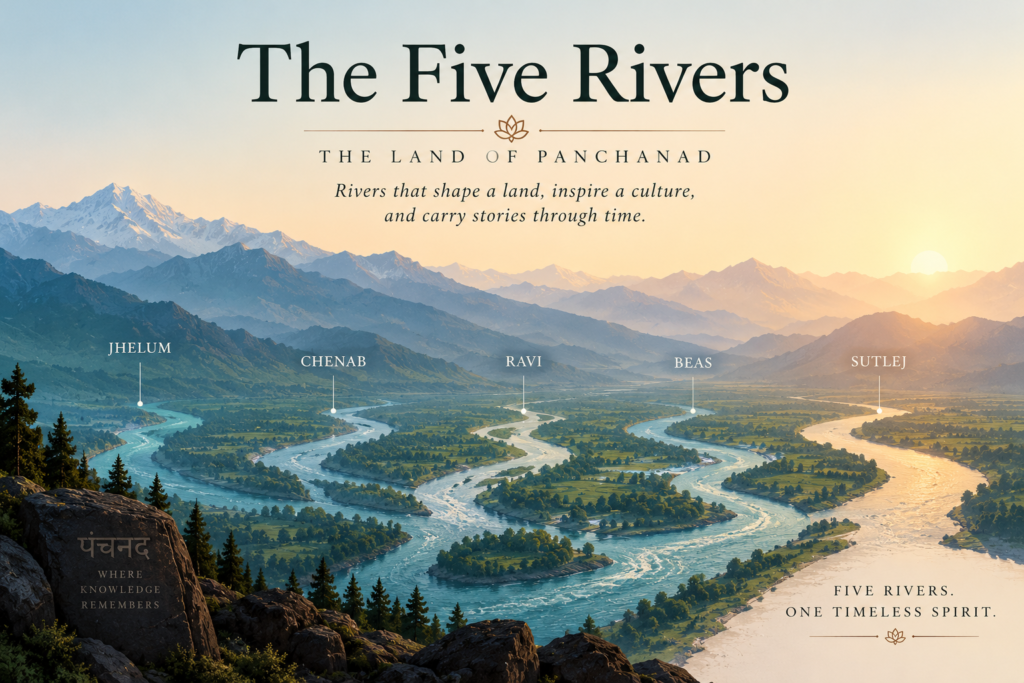
The Beas winding through northern India.

Ancient temples and sacred spaces.

Old courtyards.

Mountain settlements.

Forests disappearing into mist.

Rivers that have supported communities and accumulated stories for generations.

Architecture, geography and history can therefore become part of storytelling without needing to imitate the medieval-European settings traditionally associated with fantasy.

The Panchanad Chronicles, for example, places its young protagonists in contemporary Punjab and centres its mysteries around Panchanad Veda Sthal High School, where an apparently recognisable school environment exists alongside hidden architecture and secrets older than the buildings above them.

That combination is important.

The ancient world doesn’t have to exist somewhere far away.

It can exist underneath the ordinary world we already know.

Symbols Give Fantasy Another Language

A lotus isn’t simply a flower.

A river isn’t simply water.

Fire isn’t merely heat.

A mountain isn’t only stone.

Across Indian traditions, natural elements, objects, sounds and geometric forms can carry layers of symbolic meaning.

Fantasy gives writers the opportunity to play with this visual language.

A young reader may first encounter something because it looks mysterious or beautiful. Curiosity then encourages them to ask:

What does that mean?

And that question can lead somewhere much bigger.

Into history.

Into mythology.

Into philosophy.

Into another culture.

Or simply into another book.

That is one of storytelling’s quiet strengths: entertainment can become the doorway to curiosity.

Why This Matters for Young Readers

Children between eight and twelve are already asking surprisingly large questions.

What kind of person do I want to become?

Where do I belong?

Why should I do the right thing when nobody is watching?

What makes somebody a good friend?

When should I speak?

When should I listen?

What happens when I make the wrong decision?

Middle-grade fantasy can explore these questions without turning them into lessons.

Instead, readers experience them alongside characters.

They watch friendships tested.

They see mistakes made.

They encounter consequences.

They wonder what they themselves would have done.

And because all of this happens inside an adventure, the ideas can stay with them long after the adventure ends.

A New Generation Can Discover Ancient Ideas in New Ways

Ancient traditions survive because each generation encounters them differently.

For some, that happens through family.

For others, through history or philosophy.

And sometimes it begins with something as simple as a story.

That is where modern fantasy has an exciting opportunity.

It can take inspiration from cultural heritage without leaving it frozen in the past.

It can invite children to become curious without telling them exactly what to think.

It can introduce old questions through new characters.

And it can remind readers that knowledge isn’t valuable simply because it is ancient.

Knowledge matters because of what we choose to do with it.

That idea sits at the heart of The Panchanad Chronicles.

The series begins with four children, a school above the Beas River and questions nobody thought to ask.

Where those questions lead is another story.

And that story begins with The First Naad.

The Panchanad Chronicles
Where Knowledge Remembers.

Why Children Still Need Ancient Stories in a Modern World


Children today are growing up in a world that moves extraordinarily fast.

Information arrives instantly. Entertainment is available on demand. Screens compete constantly for attention, and even young children are becoming accustomed to content designed to be consumed, replaced, and forgotten within minutes.

Yet some of the stories that have survived for centuries move at an entirely different pace.

Ancient myths, legends, folk tales, and philosophical traditions ask children to listen, imagine, question, remember, and reflect. They introduce ideas that cannot always be reduced to a simple right or wrong answer.

Perhaps that is precisely why these stories still matter.

Ancient Stories Ask Timeless Questions

Technology changes. Human nature does not change quite as quickly.

Children still experience fear. They still wonder whether they are brave enough to do something difficult. They experience friendship, jealousy, loyalty, disappointment, curiosity, grief, responsibility, and the consequences of their decisions.

These are the same human experiences that ancient stories have explored for generations.

Across cultures, traditional stories repeatedly return to questions such as:

What does it mean to be courageous?

When should we act, and when should we wait?

What responsibilities come with knowledge or power?

What do we owe our families and communities?

Can doing the right thing sometimes require greater strength than winning?

Children may encounter these questions through magical worlds, extraordinary heroes, sacred places, mysterious creatures, or impossible challenges. Beneath the adventure, however, they are exploring situations that have relevance to their own lives.

That is one of mythology’s enduring strengths.

Wisdom Does Not Always Arrive as a Lesson

Children rarely enjoy feeling that a story is secretly a lecture.

Good storytelling works differently.

Instead of telling a child, “You must be patient,” a story can place a character in a situation where impatience has consequences.

Instead of defining courage, it can show someone frightened who chooses to act responsibly anyway.

Instead of explaining that power should be used carefully, it can give a character extraordinary power and then ask what happens when that power is misused.

The reader reaches the lesson through the experience of the character.

This distinction matters because stories give children space to form their own conclusions.

A child might finish an adventure remembering the mystery, danger, friendship, or magic. Yet underneath those elements, the story may have quietly introduced ideas about responsibility, compassion, self-control, loyalty, or courage.

The lesson becomes part of the story rather than an instruction attached to it.

Cultural Stories Give Children Something Else: Roots

There is another reason traditional storytelling matters.

Stories help children understand where people come from.

India possesses an extraordinarily rich storytelling heritage shaped by mythology, philosophy, oral traditions, regional folklore, sacred symbolism, poetry, history, and generations of family storytelling.

Ideas associated with dharma, mantra, agni, surya, chandra, rivers, temples, nature, duty, knowledge, and the relationship between action and consequence carry layers of meaning developed across centuries.

Introducing young readers to culturally rooted ideas does not mean turning fiction into a history or religious textbook.

The most compelling children’s stories allow culture to exist naturally within the world.

A river can be both a geographical place and something generations have attached stories to.

Fire can provide warmth while also symbolising transformation.

The sun can represent light while prompting ideas about truth and clarity.

The moon can invite thoughts about patience, cycles, memory, and change.

When these ideas become part of an adventure rather than a classroom definition, children encounter culture through curiosity.

Representation Can Be More Than Seeing Someone Who Looks Like You

Representation in children’s literature is often discussed in terms of characters, and that is important.

But meaningful representation can go much deeper.

Children can also recognise landscapes, family relationships, languages, values, architecture, food, symbols, traditions, and ways of thinking.

A young reader with Indian heritage might encounter a familiar word or cultural reference and experience the pleasure of recognition.

Another child encountering that world for the first time may experience something equally valuable: discovery.

Both experiences matter.

Children’s fantasy has an extraordinary ability to make unfamiliar worlds inviting. A reader does not need to share a character’s background to understand curiosity, friendship, fear, courage, or the desire to belong.

The culturally specific can therefore become surprisingly universal.

Fantasy Gives Ancient Ideas New Life

There is sometimes an assumption that preserving ancient stories means simply retelling them exactly as they have always been told.

Retellings certainly have an important place, but they are not the only possibility.

Writers can also take inspiration from older traditions to create entirely new worlds, characters, mysteries, and adventures.

That distinction is important.

A contemporary fantasy story can draw upon ancient philosophy or symbolism without pretending to be an ancient text itself. It can respect its cultural foundations while allowing young characters to encounter those ideas through problems that feel emotionally understandable to a modern reader.

A centuries-old concept can suddenly become a question faced by a twelve-year-old.

What would you do if you discovered something powerful?

Would you tell your friends?

Would you use it?

Would you hide it?

And what if the wisest decision was not to use it at all?

Suddenly, philosophy becomes adventure.

Children Need Heroes Who Think as Well as Act

Modern entertainment often associates heroism with action.

The hero fights.

The hero wins.

The hero defeats the enemy.

But many older philosophical traditions offer a more complicated understanding of strength.

Sometimes courage means acting.

Sometimes it means refusing to act recklessly.

Sometimes strength means protecting someone.

Sometimes it means admitting fear.

Sometimes knowledge provides an advantage.

Sometimes wisdom means recognising that possessing knowledge does not automatically give someone the right to use it.

These distinctions are particularly valuable for children because they expand the definition of what a hero can be.

The thoughtful child can be heroic.

The patient child can be heroic.

The child who notices what everyone else ignores can be heroic.

The child who protects friends can be heroic.

Even the child who changes their mind after realising they were wrong can be heroic.

Adventure becomes more interesting when there is more than one form of courage.

Stories Can Create Conversations Between Generations

Culturally rooted stories can also accomplish something beyond reading.

They can start conversations.

A child encounters an unfamiliar word and asks a grandparent what it means.

A story mentions a river, symbol, festival, tradition, or historical idea, and a parent shares something they remember from childhood.

A classroom discussion begins with a fantasy adventure and develops into conversations about geography, history, ethics, culture, or philosophy.

The book eventually closes, but the conversation continues.

That is one of the most powerful possibilities of children’s literature.

Stories do not have to provide every answer.

Sometimes their greatest contribution is giving children better questions to ask.

A Counterbalance to the Age of Short-Form Attention

There is also something quietly valuable about asking a child to spend time inside a story.

Reading requires participation.

The reader has to imagine the school, river, forest, hidden passage, character, sound, or mysterious object. Unlike a video, the finished world is not supplied entirely by someone else.

Part of it must be constructed in the child’s mind.

Mystery strengthens this experience because it rewards attention. A detail from an earlier chapter may suddenly matter later. A seemingly ordinary object may have significance. Something a character ignored may turn out to have been important all along.

Reading teaches children that paying attention can be rewarding.

In an environment increasingly designed around instant stimulation, that is a valuable habit.

Old Wisdom, New Questions

The goal of introducing ancient wisdom to children should not be to convince them that everything old is automatically correct.

Quite the opposite.

The richest traditions survive because generation after generation continues interpreting, questioning, discussing, and rediscovering them.

Children should be allowed to do the same.

Why did a character make that decision?

Was it fair?

What would I have done?

Was the courageous choice also the wise choice?

Does having the ability to do something mean we should do it?

These questions transform reading from passive entertainment into active thought.

And perhaps that is where ancient storytelling remains most relevant.

The world children inherit will be dramatically different from the one their grandparents knew. They will live alongside technologies, professions, and challenges that previous generations could barely have imagined.

But they will still need courage.

They will still need patience.

They will still need friendship, curiosity, judgement, responsibility, and a sense of where they came from.

The settings may change.

The questions endure.

And sometimes an old story—or a new story carrying something old within it—is exactly where those questions begin.